
01/
Out of the woods
For most of Eden and Sable’s life, the brand has existed at a distance.
A photograph on a screen. A collection page. A sketch becoming a sample, becoming a finished piece, becoming another photograph.
This August, for the first time, we stepped out from behind the screen. Eden and Sable made its pop-up debut at M.A.D. Festival in Montreal. And for four days, a small corner of a shipping container, and the little stretch of festival space in front of it, became ours.
02/
Building a little world
The weeks leading up to M.A.D. were an exercise in figuring things out.
How do you translate the world of a collection into a space someone can actually walk into?
And, perhaps more importantly, how do you do that when your space turns out to be much smaller than originally imagined?
The festival pop-ups are housed inside shipping containers, with brands transforming their temporary spaces into miniature shops of their own. Our answer was to borrow from the world that inspired Prelude I — A Midsummer Night’s Dream in the first place. Or at least, that was the plan.
In my head, the container would become a little forest. There would be a moon, climbing vines, greenery and soft points of light. The collection would exist inside the world that had inspired it.
The reality was considerably less perfect.
My handmade moon was wonky. The climbing vines I had imagined became essentially one lonely vine hanging in a corner. I spent an unreasonable amount of time worrying about how the inside of the container would look, only to discover that most people barely went inside. There were practical realities too: nothing could be drilled or painted onto the container, installations needed to be largely freestanding, and fabrics and decorative materials had to meet the festival's fire-safety requirements.
So the idea changed.
And changed again.
Eventually, leaves and a tree found a home in one corner. The wonky moon became our backdrop anyway. Fairy lights illuminated the darkened space. A room divider and mirror created a tiny place to try things on. Most importantly, the clothes moved outside.
Crochet pieces hung on a rack in front of the container where people walking through the festival could see them, touch them and stop for a closer look. Nearby, small cards carrying lines from Shakespeare sat on a tree stump for visitors to take, a tiny message from the forest to carry home.
Getting there wasn't entirely a solo effort either. My family helped me bring so many of the pieces together, from preparing the space to setting everything up, and continued to show up for me throughout the festival.
It wasn't the little world I had drawn in my head. But eventually, there was half of Container 50. Imperfect, improvised and ours
03/
Seeing the clothes differently
One of the strangest things about selling clothing online is how much gets lost between the object and the photograph..
Crochet is particularly difficult. A photograph can show a silhouette, but it doesn't quite communicate the weight of a piece in your hand. It doesn't show the stitches the same way your eyes see them up close. It can't quite explain the amount of work hidden inside something handmade.
At M.A.D. festival, people could touch the pieces. They could look closely at the construction. They could see the colours without a screen interpreting them first. They could ask how something was made. And I could watch their reactions.
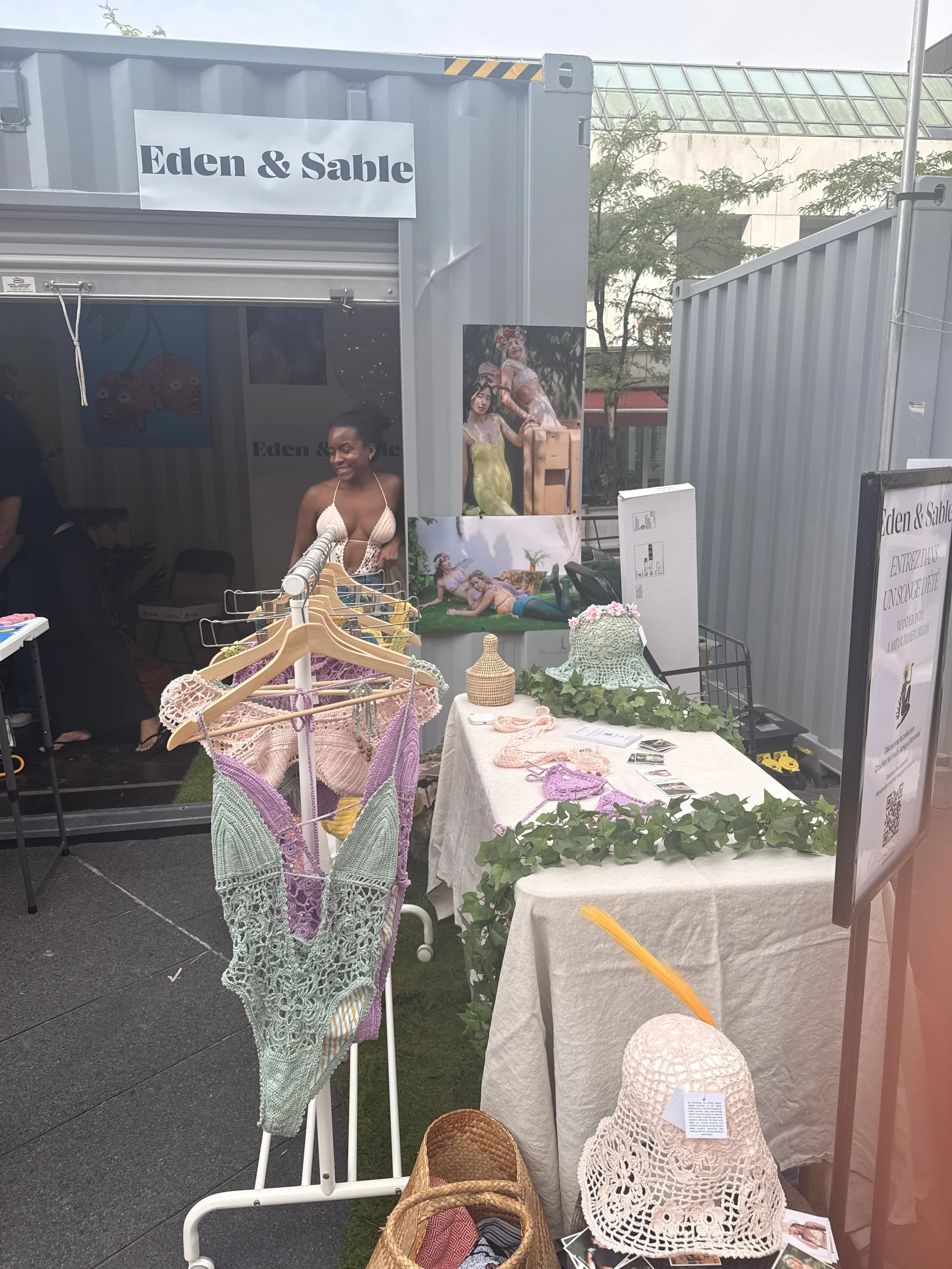
People stopped because something caught their eye.
I heard, “These are really beautiful.”
Someone told me, “You've done an amazing job. These are beautifully made.”
Others commented on how attractive the colours were.
One couple recognized the Egyptian cotton and immediately understood the quality of the material. Others noticed that the pieces were lined and understood what that added to their construction, durability and finish.
And some people understood the prices.
That mattered to me. After spending so much time working on Eden & Sable largely behind the scenes, there was something significant about watching strangers discover it without me first having to explain what they were supposed to see.
They noticed.
04/
the other side of the experience
I could stop here and write the tidy version of this story. But building a small brand is rarely tidy. Most times it’s messy and heart breaking.
The days were long, the August sun was hot, and by the end of the weekend I was exhausted. My family was there every step of the way, taking turns beside me and helping me make it through all four days. And through all of it, I was waiting to see if someone would buy something.
I went into the festival knowing Eden and Sable wasn't an obvious festival purchase. These are handmade pieces with prices that reflect the time, materials and labour required to make them. A person wandering through a festival on a Saturday afternoon may admire a $300 or $400 piece without being prepared to buy one.
I knew that. But knowing something intellectually and experiencing it are two different things.
We didn't make a sale.
That was difficult.
Saturday had given me a little hope. There were people who seemed genuinely interested in owning a piece, and somewhere along the way I let myself imagine that perhaps someone would come back. There was no particular reason to believe they would. But sometimes hope does that. It takes a possibility and quietly turns it into an expectation.
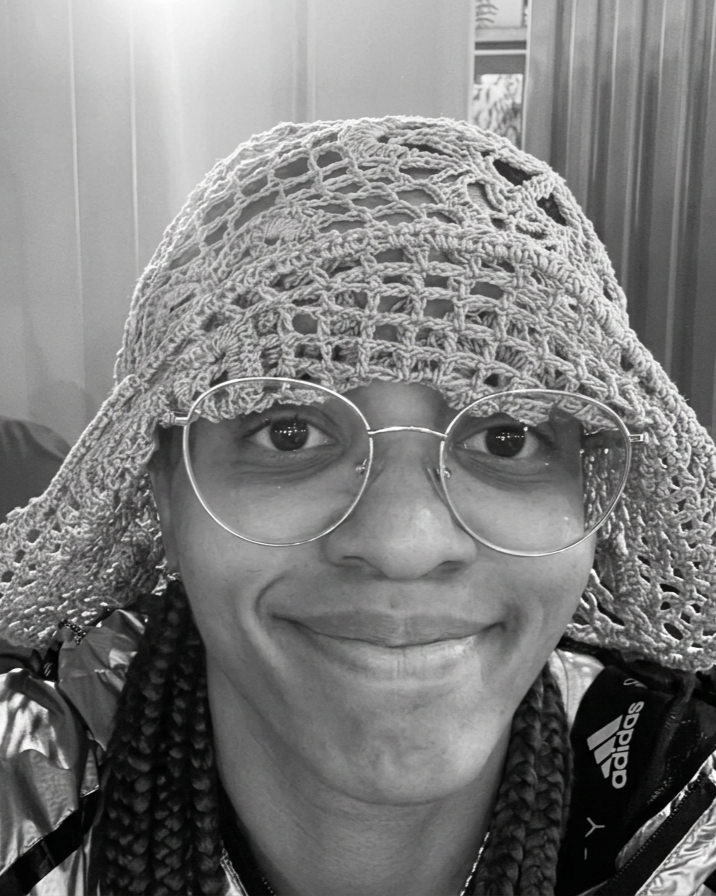
A smile meant to hide defeat.
Then Sunday, the last day of our four day pop-up, came with rain. There were fewer people wandering through our part of the festival, and as the final hours passed, I could feel that little bit of hope disappearing.
Towards the end of the last night, it became difficult to hold back the tears.
Part of me felt foolish. I had given myself false hope even though I knew better. I knew the reality of the event. I knew our price point. I knew that someone loving a piece didn't mean they were going to buy it.
But I had still wanted one sale.
Just one.
And when it didn't happen, there were moments when it was hard not to interpret that zero as a verdict on everything that had come before it, the designing, sampling, photographing, building, packing, carrying, setting up and simply trying to make this very small brand exist.
I felt defeated.
There's no particularly elegant way to rewrite that part.
I was tired, disappointed and wondering, again, whether all of this effort would ever turn into something sustainable.
It would be easy to reduce the weekend to a number. Zero.
But that wouldn't actually tell the whole story.
05/
What I brought home
For the first time, I had the opportunity to observe people encountering Eden and Sable in person.
And that gave me something analytics never really have.
Context.
I saw people stop. I heard what they responded to. I watched them examine the crochet and ask about how the pieces were made. I heard the compliments. I saw people recognize the quality of the materials and construction. I also saw the hesitation when people reached the price. That last part matters just as much as the compliments.
Eden and Sable was never intended to compete with mass-produced swimwear. The work is slow. The pieces are handmade in small quantities. There is a reason they cost what they do.
M.A.D. festival didn't necessarily tell me that the price needed to change. It made the question of who we need to reach much clearer. There is a difference between finding people who appreciate something and finding the people who value it enough to buy it.
I haven't figured out that part yet. But I will.
What I do know is that I understand a little more than I did before. And for now, that has to be enough to keep going.
06/
The first, not the last
I don't think every milestone in a small business arrives looking like a success story. Sometimes the milestone is simply doing the thing you hadn't done before. We built our first physical Eden and Sable space.
People stopped.
They touched the clothes.
They examined the stitches.
They took little messages home with them.
They discovered a brand they hadn't known existed five minutes earlier.
And I got to see Eden and Sable outside of my own head, my studio and my computer screen. For a brand that began as an idea and has spent years slowly finding its shape, that feels worth recording.
M.A.D. Festival wasn't the triumphant ending to a chapter. It was fieldwork. A first experiment in what Eden and Sable might look like in the real world and a reminder that figuring out where we belong is part of building the brand too.
I left disappointed. I left with questions. And yes, a part of me left feeling defeated. But I didn't leave ready to stop.
There is still more to make. More to learn. And more of Eden and Sable still to become.